UPI Was Free for Years. Now MDR Is Coming, But Why?
For most Indians, UPI has reached a point where we don't even think about the technology behind it anymore.
You buy chai for ₹20 then scan. You pay ₹350 at a restaurant then scan. You buy a phone for ₹30,000 then scan.
The money moves almost instantly and normally there is no extra charge shown anywhere. That simplicity is probably one of the biggest reasons UPI became so successful.
But there is one thing we rarely think about. If we are not paying anything for a UPI transaction, who is paying for the system which makes that transaction possible?
That question has now become important because India's UPI payment model is changing.
From October 15, 2026, certain UPI payments made to merchants above ₹2,000 will attract a 0.4% Merchant Discount Rate or MDR.
This does not mean every UPI payment above ₹2,000 will suddenly become chargeable. Person-to-person transfers will continue to remain completely free. The new charge is for certain person-to-merchant (P2M) transactions above ₹2,000, and the merchant pays the charge, not the customer. The government says around 96% of merchant UPI transactions will remain unaffected.
How does UPI actually work?
A common misunderstanding is that when you send money through Google Pay, PhonePe, Paytm or another UPI app, that company itself is moving the money. That is not exactly what happens.
Your UPI app is mainly the interface through which you start the transaction. The actual money moves from one bank account to another bank account, coordinated by the National Payments Corporation of India (NPCI), which operates the UPI network connecting banks and payment applications.
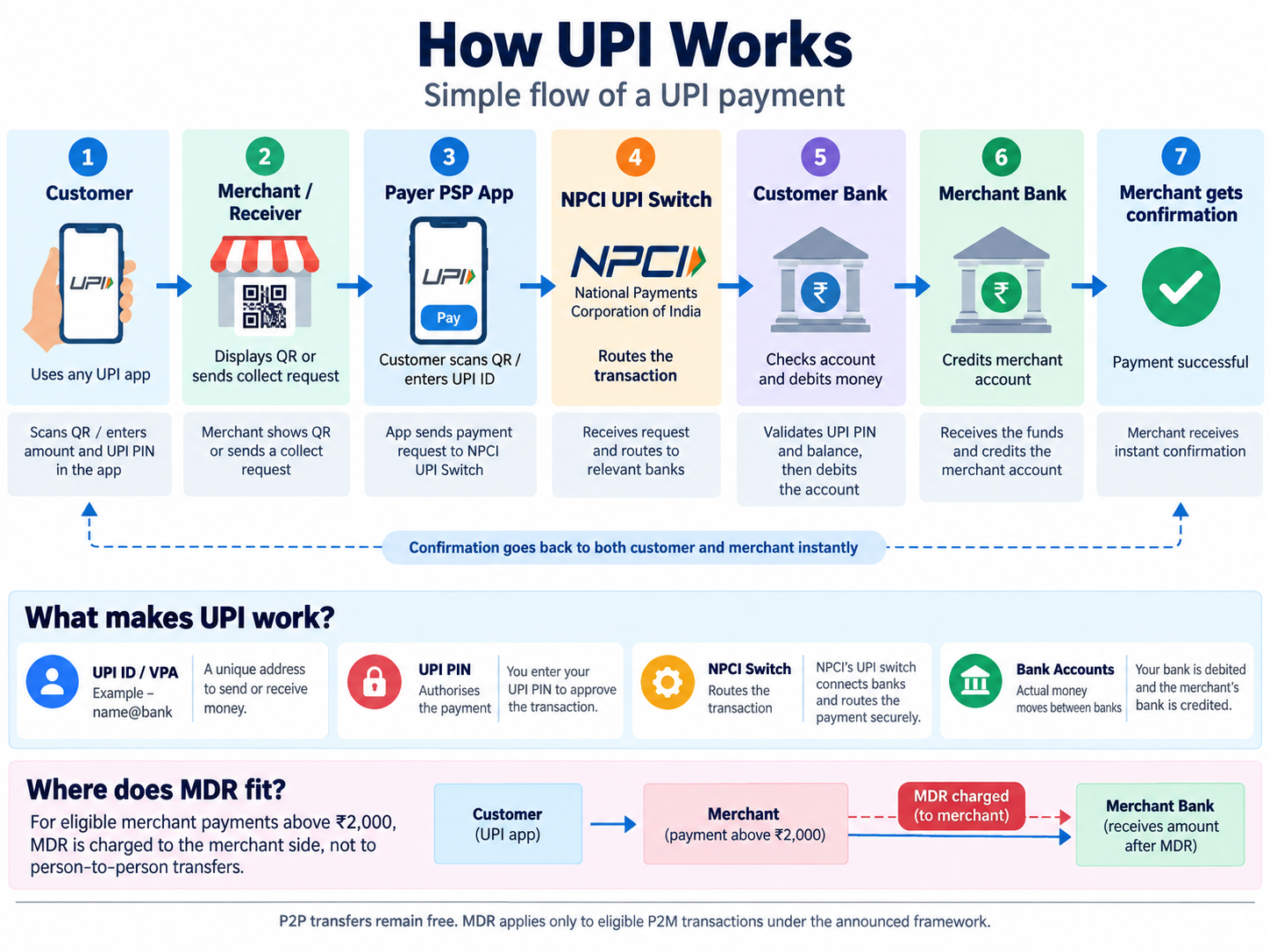 How a UPI payment moves through the system in seven steps, and where MDR applies.
What is a UPI ID?
A UPI ID or Virtual Payment Address is basically an easier address for your bank account, something like ramesh@okhdfcbank, instead of a full account number, branch and IFSC code.
All this infrastructure is not free
Banks maintain payment servers, NPCI operates and scales the network, fraud detection and cybersecurity systems run continuously, and everything needs redundancy at national scale. Industry estimates cited by the Parliamentary Standing Committee on Finance put the annual operating cost of the UPI ecosystem at around ₹20,700 crore, against roughly ₹2,000 crore allocated under the zero-MDR incentive regime for 2026-27.
What exactly is MDR?
MDR (Merchant Discount Rate) is a processing fee charged to the merchant for accepting a digital payment, the same concept that already applies to credit and debit cards. UPI has operated MDR free since January 2020 to encourage adoption.
From October 15, eligible merchant UPI payments above ₹2,000 will carry an MDR of 0.4%, capped at ₹300 for transactions above ₹75,000. Small merchants receiving up to ₹1 lakh per month via UPI QR are exempt, and sectors like railways, fuel and telecom get a lower flat charge.
Why ₹2,000?
In FY2025-26, only around 4% of P2M UPI transactions were above ₹2,000 but those represented roughly two-thirds of P2M UPI value. The policy leaves small everyday payments untouched while drawing revenue mainly from larger commercial transactions.
Will customers actually remain unaffected?
Officially, the customer does not pay MDR — the merchant does, and the government has said this should not be passed on to consumers. In practice, merchants could still adjust prices, discounts, or payment method preferences at the margin. That is worth watching once the system goes live.
UPI's second phase
The first phase of UPI was about adoption: simple, cheap, interoperable, everywhere. That experiment worked. The second phase is about making the system financially sustainable without undoing what made it succeed. The new 0.4% MDR above ₹2,000 is one attempt at that balance — small merchant transactions and P2P transfers stay free, while larger commercial payments start contributing to the infrastructure they use.
Whether the balance holds will become clearer after October 15.